Risk Analysis in Theory and Practice
Presenting a mix of conceptual analyses and applied problems, this book provides useful insights into the economic rationality of decision-making under uncertainty.
 TABLE OF CONTENTS
 The concept of optimization is central to economic analysis and efficiency. Economic rationality means that economic agents do the best they can to improve their welfare. This is represented by an optimization problem: Decisions are made so that each agent maximizes his/her objective function subject to constraints imposed by the economic environment. The objective function is a utility function representing the agent s preferences. The agent can be a household making consumption decisions or a firm making production and investment decisions. Under uncertainty, the utility function reflects risk preferences. In this context, the analysis of economic decisions involves maximization problems subject to feasibility constraints. Below, we review standard tools of analysis based on optimization methods. These tools are used throughout this book to generate useful insights into decision-making under uncertainty and the efficiency of risk allocation.
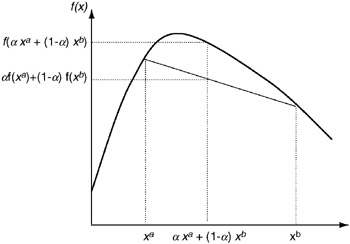
Consider a function f( x), where x = ( x 1, , x n) is an n-vector of real numbers. This means that for each x, there exists a unique real number given by f( x). The function f is said to be concave if, for any x a and x b and any ?, 0 ? ? ? 1,

This is illustrated in Figure B.1.
When the function f is differentiable, let f ?( x) ? ? f/ ? x denote the first derivative of f,...