Risk Analysis in Theory and Practice

Presenting a mix of conceptual analyses and applied problems, this book provides useful insights into the economic rationality of decision-making under uncertainty.
 TABLE OF CONTENTS
 In Chapter 11, we presented a general analysis of the economic efficiency of risk allocation. We showed that efficient risk allocations have two objectives: (1) to reduce private risk exposure and redistribute the risk away from risk-averse individuals, and (2) to improve the quality of the information available in the decision-making process. However, the implementation of these objectives can be complex. This chapter focuses on some applications. Specific applications lead to more specific efficient decision rules. This provides additional insights on the economics of contract and policy design under imperfect information.
A generic issue in risk allocation is how to redistribute risk within a group of individuals. Here, we consider the case where the risk is associated with the outcome of a public project. The public project involves an ex-ante investment x that generates an uncertain net monetary return ?( x, e), where e is a random variable representing the uncertainty. The questions are: (1) How much to invest? and (2) How to redistribute the benefits of the public investment under uncertainty?
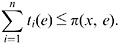
Assume that there are n individuals involved. Denote by  the decision rule giving the net payment made to the i-th individual when the random variable takes the value e. Feasibility implies that
The ex-ante utility function of the i-th individual is  , i = 1, , n. This means that the only benefit of the public investment x comes from the redistribution...