Stratigraphic Reservoir Characterization for Petroleum Geologists, Geophysicists, and Engineers: Handbook of Petroleum Exploration and Production, Volume 6

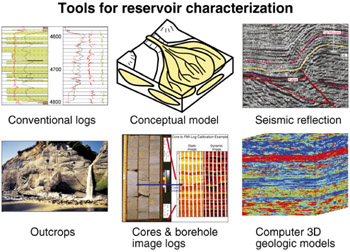
The three main stages of field development are exploration (through to discovery), appraisal, and production. In exploration, one starts with a conceptual geologic model (Fig. 2.2), which may be based on geologic knowledge of the area, including basin evolution, structure, and stratigraphy (labeled 1 in Fig. 2.3). Conventional 2D or 3D seismic-reflection analysis (Fig. 2.2) normally is the next phase of exploration, because subsurface seismic profiles and 3D volumes can provide a regional-scale image of the area being explored (labeled 2 in Fig. 2.3). If the seismic data reveal potential drill sites, and a well is drilled, the well is logged with conventional logging tools (Fig. 2.2) to determine rock and fluid properties in the wellbore (labeled 3 in Fig. 2.3).
If potentially economic accumulations of hydrocarbons are found in the exploratory well (labeled 4 in Fig. 2.3), the decision may be made to drill more wells...