Stratigraphic Reservoir Characterization for Petroleum Geologists, Geophysicists, and Engineers: Handbook of Petroleum Exploration and Production, Volume 6

2.5: Drilling and Sampling a Well

2.5 Drilling and Sampling a Well

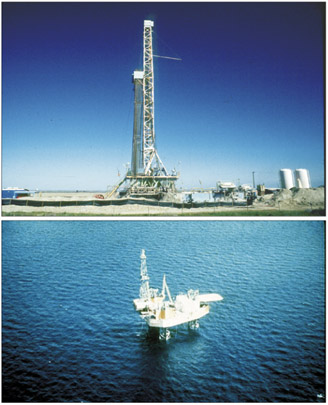
The only real way to identify subsurface rock types and their contained fluids is to drill a well and sample what is in the wellbore. Wells can be drilled on land with a land rig, or at sea from a floating platform or drillship (Fig. 2.33). The basic parts of a drill rig are shown in Fig. 2.34A. The drill bit is attached to a drill string of pipe that rotates through a turntable on the rig floor. At the end of the drill string is a drill bit that cuts through the rock. A water mud mixture (slurry) is continuously pumped down the hole to provide lubrication for the drilling and also to catch pieces of the borehole as it is cut. These pieces, called "cuttings", are carried upward to the ground surface by the circulating mud and are caught in a trap. Normally, a mud logger examines the cuttings on the drill floor, records the lithology, and measures the contained reservoir fluids, then bags the cuttings for future, more-detailed examination. To facilitate a thorough examination of cuttings samples for their lithology, composition, and for the presence of microflora and microfauna, the drilling mud must be washed from the cuttings to provide a clean sample (Fig. 2.35). Cuttings analysis may include relative proportions of rock types, biostratigraphy, and mineralogy (Fig. 2.36).


Figure 2.33: The only real way to determine the types of rocks in the subsurface is to drill a well. Except in very...

UNLIMITED FREE
ACCESS
TO THE WORLD'S BEST IDEAS

SUBMIT
Already a GlobalSpec user? Log in.

This is embarrasing...

An error occurred while processing the form. Please try again in a few minutes.

Customize Your GlobalSpec Experience

Category: Shale Shakers
Finish!
Privacy Policy

This is embarrasing...

An error occurred while processing the form. Please try again in a few minutes.