Stratigraphic Reservoir Characterization for Petroleum Geologists, Geophysicists, and Engineers: Handbook of Petroleum Exploration and Production, Volume 6

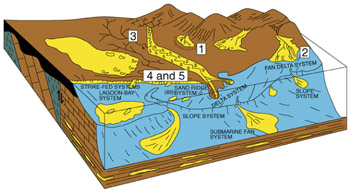
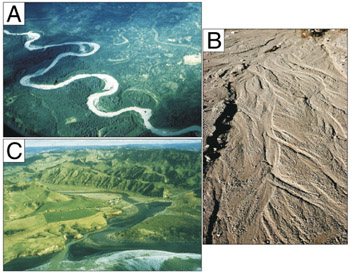
Fluvial deposits are sediments that are transported and deposited by rivers in a continental environment (Fig. 6.1). There are several types of fluvially derived deposits, including (1) alluvial fans, which are fan-shaped sediment bodies that form at the bases of mountain slopes at the mouths of rivers; (2) fan deltas, which also form at the bases of mountain slopes, but which are deposited very near a marine shoreline and in marine waters; (3) braided-river deposits, which form at and beyond the bases of mountains, where the gradient of the ground surface is relatively steeply inclined, (4) meandering-river deposits, which form on more gently inclined floodplains, and (5) incised-valley-fill deposits which fill preexisting continental valleys (Fig. 6.1). Each of these types of deposits exhibits a unique set of properties that distinguish it from the others, including grain size, sand-body geometry, orientations, flow barriers, and the like (Fig. 6.2). An understanding of these differences is important to the evaluation of a subsurface reservoir, because these properties affect fluid flow and ultimately, reservoir performance. It is not sufficient to know that your reservoir is a "fluvial" reservoir; you must also know the type of fluvial reservoir and its defining characteristics.