Stratigraphic Reservoir Characterization for Petroleum Geologists, Geophysicists, and Engineers: Handbook of Petroleum Exploration and Production, Volume 6

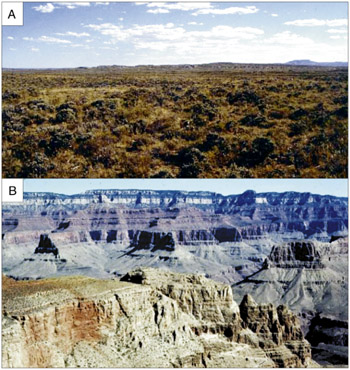
Figure 2.8A shows a flat ground surface. By looking at the surface, there is no way that someone can truly know the geologic structure and stratigraphy that lie beneath it. The Grand Canyon (Fig. 2.8B) provides one rare example of being able to see the geology in a vertical section to a depth of about 1.6 km (1 mi) beneath the ground's surface. Seismic-reflection acquisition, or "shooting", provides an image of the subsurface that is not as detailed as the true geology, but that is adequate for imaging large- to medium-scale geologic structures and stratigraphy. Seismic-reflection analysis has become the dominant tool used in hydrocarbon exploration, and with some resolution limitations, it is becoming widely used for characterizing reservoirs.
The seismic-reflection method is based on the principle that an energy source, such as dynamite, generates sound waves that travel through the earth (Fig. 2.9A). When the sound waves reach an interface between two rocks that have different acoustic properties, some of the waves' energy will continue to penetrate through the rock beneath that interface, but some of the energy will...