Stratigraphic Reservoir Characterization for Petroleum Geologists, Geophysicists, and Engineers: Handbook of Petroleum Exploration and Production, Volume 6

Eolian (windblown) sandstone deposits can form excellent oil and gas reservoirs. Wind is a very effective agent for sorting sand-size, silt-size, and clay-size grains, both vertically within the air column and horizontally in the downwind direction. Therefore, at any given eolian depositional site, the deposit will tend to be fairly well-sorted by grain size. Good sorting often leads to good reservoir quality (Chapter 5).
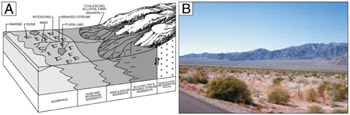
Arid deserts are one of the two major types of environments in which eolian sands are deposited. Often, windblown sands are deposited within an arid inter-montane basin. In such a setting, the source of the sand may be alluvial fans that fringe the mountain range and that are subjected to frequent winds (Fig. 7.1). Also, intermittent rivers that flow only during wet periods transport fluvial sediment to the wadi basin (a wadi is a desert channel or dry wash through which an intermittent river flows; the term also applies to the closed desert basin, where the wadi terminates, that is filled with fluvial sediments deposited by the intermittent river). Such fluvial deposits can be reworked later into eolian deposits. Inland sand-sea deposits often are quite thick and areally extensive (Fig. 7.2). They form part of a larger nonmarine system of alluvial-fan, braided-river, sand-sea, and playa-lake environments. They sometimes occur on a coastal plain leading downslope to a marine environment (Fig. 7.1).