Stratigraphic Reservoir Characterization for Petroleum Geologists, Geophysicists, and Engineers: Handbook of Petroleum Exploration and Production, Volume 6

I Nyoman Suta and Budi Tyas Utomo
PetroChina International, Jakarta, Indonesia
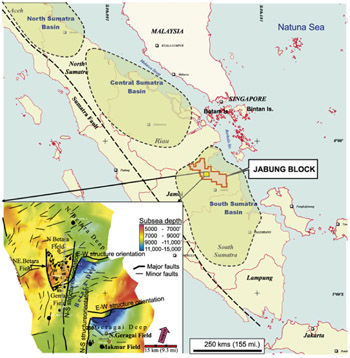
This chapter presents an example of a reservoir characterization using a variety of data, including a 3D seismic survey covering 455 km 2 (175 mi 2), conventional logs from 30 wells, four wells with pressure data (repeat formation tester, RFT and modular dynamic tester, MDT data), conventional and sidewall cores, formation micro-imager (FMI) logs from two wells, and a plethora of reports and data on geochemistry, biostratigraphy, cuttings descriptions, reservoir fluid analysis/PVT, DST data and the like (PetroChina Inc., 1998a-1998d). The field presented here is the Northeast Betara field, in the Jabung block, which is located in the northern side of the South Sumatra Basin, Indonesia (Fig. 12.1). Regional geology and tectonic history of the area have been detailed by Suta (2004).
Northeast Betara field occupies the platform of the basement high to the north of the northeast-trending bounding fault that separates the field from the Gemah field to the south (Fig. 12.2). North-facing normal faults bound the field on the north. The field is bounded by a reverse fault on the west, and on the east by a reactivated normal...