Characterisation of Polymers, Volume 1

Most methods for the determination of carboxyl groups in polymers are based on titration techniques including, for example, the following copolymers: acrylic acid - itaconic acid [29], acrylic acid - ethyl acrylate [30] and maleic acid-styrene [31]. High-frequency titration has been applied [32] to the analysis of itaconic acid - styrene and maleic acid - styrene copolymers and ethyl esters of itaconic anhydride - styrene copolymers. The method can also be used to detect traces of acidic impurities in polymers and in the identification of mixtures of similar acidic copolymers. Titration indicates that the acid segments in the copolymers of itaconic acid - styrene and maleic acid - styrene, and the homopolymer polyitaconic acid, act as dibasic acids. The method has a sensitivity that permits identification and approximate resolution of two carboxylate species in the same polymer, for example:
Polyitaconic acid

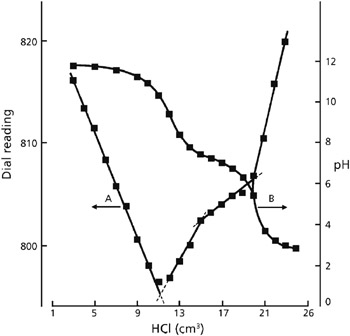
High frequency titration gives a precise location of the inflection points related to the polymer carboxyl groups and is a sensitive method for the determination of the freedom of the copolymer samples from monbasic acid impurities (comonomer acids), since mixtures of copolymer acids with monobasic and dibasic acids show definite inflection points that can be related to the individual carboxylate species present.
A titration curve (Figure 3.3) is shown for a monomethyl ester of an itaconic acid-styrene copolymer.