Characterisation of Polymers, Volume 1

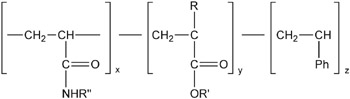
Anderson and co-workers [80] have studied the application of an alcohol exchange gas chromatographic method to the determination of etherification levels in acrylamide interpolymers of the type:

where
R = H or CH 3
R ? = H, CH 3, C 2H 5, C 4H 9 OR C 8H 17
R ? = H, CH 2OC 4H 9 or CH 2OH
In this method a cast film of the acrylamide interpolymer is reacted with an alcohol, e.g., octyl alcohol, to exchange with etherifying alcohols present in the polymer backbone as follows:

The etherifying alcohol content of the digest, in this case butanol, is determined by gas chromatography. The method is calibrated against standard solutions of the etherifying alcohol and an internal standard.
The level of alcohol obtained during the exchange reaction of acrylamide is correlated with data obtained using Zeisel cleavage of the alkoxy groups. These data are summarised in Table 3.9. Comparable results are obtained using both procedures, however, the Zeisel cleavage reaction will also cleave ester linkages as well as ether functionalities. This presents no problem with polymers which do not contain ester groups. In systems employing both butyl esters and butyl ethers the Zeisel cleavage reaction gives a total O-C 4H 9 content in the sample. Alcohol exchange, on the other hand, will cleave only the butyl ether groups in the sample. By subtracting the alcohol...