Characterisation of Polymers, Volume 1

The methods described in this section cover only the determination of total unsaturation. Distinction between different types of unsaturation, (e.g., cis, trans 1,2, trans 1,4) will be discussed in a subsequent volume.
Unsaturation in polymers is usually measured by physical techniques, as discussed later. This is especially so in the case of low levels of unsaturation, or in instances where a distinction has to be made between different types of unsaturation. Hydrogenation techniques have been used, however, to measure higher levels (0.5-5.0 mole%) of total unsaturation in polymers, a good example of which is the determination of terminal unsaturation in polystyrene oligomers [103-105] (low molecular weight polymers), e.g., polystyrene dimer:
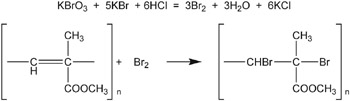
In acidic medium potassium, bromide and potassium bromate produce bromine stoichiometrically, and this is the basis of a titration method [106] for determining double bonds in polymethylmethacrylate. After bromination, excess bromine is estimated by the addition of potassium iodide, and the iodine produced estimated by titration with standard sodium thiosulfate to the starch end-point:

Hensen and Eatough [107] have described a direct injection enthalpimetric determination of residual total unsaturation in polymers which is based on the heat produced during the bromination of double bonds. Koltoff and Mitarb [108] and Boyers [109] both discuss the application of bromination to the determination of total unsaturation in di and polyolefins. McNeil [110, 111] has discussed methods for the determination of total unsturation based on chlorination with radiochlorine ( 35Cl). This...