Characterisation of Polymers, Volume 1

3.3: Carbonyl Groups

3.3 Carbonyl Groups

Germanenko [47] determined low concentrations for carbonyl groups in PVC and vinyl chloride - vinyl acetate copolymers. In this method the carbonyl groups in the polymer are reacted with 2,4-dinitrophenyl hydrazine to produce the corresponding phenyl-hydrazone. Excess reagent is washed away from the polymer, which is then digested with concentrated sulfuric acid to convert the bound hydrazone to ammonium sulfate, which is then estimated using Nessler's reagent.

Direct spectrophotometry in the visible and ultraviolet region been used to determine low concentrations of functional groups on the surface of polymer films. Thus, Kato [48] has followed the regeneration of carbonyl groups from 2,4-dinitrophenyl-hydrazones formed on the surface of irradiated polystyrene films by absorption measurements at 378 nm.

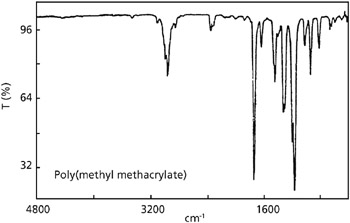
In the infrared spectrum of pyrolysed polymethacrylic acid a carbonyl stretching band is clearly visible at 5.73 ?m. Also evident is the ester stretching band at 9.82 ?m (Figure 3.5).


Figure 3.5: Infrared spectrum of pyrolysed polymethacrylic acid.
(Source: Author s own files)

UNLIMITED FREE
ACCESS
TO THE WORLD'S BEST IDEAS

SUBMIT
Already a GlobalSpec user? Log in.

This is embarrasing...

An error occurred while processing the form. Please try again in a few minutes.

Customize Your GlobalSpec Experience

Category: Organic Chemicals
Finish!
Privacy Policy

This is embarrasing...

An error occurred while processing the form. Please try again in a few minutes.