Chapter 1
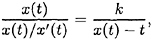
Problem 1.1 Let 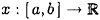 be the curve we are looking for. The condition in the problem reads as
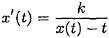
or equivalently
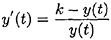
for every t ? [a, b]. This is a differential equation reducible to one with separable variables. The change of unknown function y=x ?t leads to
for every t ? [a, b], whose general solution is defined by y+ln k ?y+ t+ c=0, with c an arbitrary constant. It then follows that the family of curves with the desired property is implicitly defined by x+ln k ?x+t+c=0,  .
.
Problem 1.2 Let  be the curve we are looking for with
  and let A(a, 0) and B(0 , b) be the intersection points of the tangent to the curve at the point (t, x(t)) with the coordinate axes. Since (t, x(t)) is the middle point of the segment AB, we have a=2 t and b=2 x. See Figure 9.1.1.
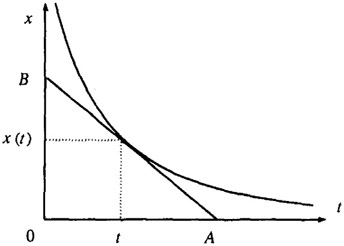 Figure 9.1.1
 On the other hand, the slope of the tangent at the current point (t, x(t)) is x ?(t). The condition in the problem expresses by  , or equivalently by tx ?(t)= ? x(t). The equation above is with separable variables and has the general solution tx=c, with c real constant. Since x(3)=2, we deduce c=6. Consequently, the desired curve is the hyperbola of...

 TABLE OF CONTENTS