Problem 4.1 If x is bounded on  , there exists m>0 such that
for every  . From the second equation in (
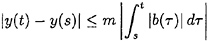
  ), we deduce
for every  . Since b is absolutely integrable over
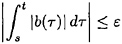
  , for every ?>0 there exists ?( ?)>0 such that
for every  , with t ? ?( ?) and s ? ?( ?). From the inequality previously established, it follows that y satisfies the Cauchy s condition of the existence of the finite limit at + ?. Let ?=lim t ?+? y(t). It follows then that lim t ?+? x'(t)= ?. Assuming by contradiction that ? ?0, we deduce that x is unbounded. Indeed, to fix the ideas, let us assume that ?>0. Then, there exists t 0>0 such that, for every t ? t 0, we have
  . Accordingly x is unbounded on . This contradiction can be eliminated only if ?=0, which proves (i).
In order to prove (ii), let us observe that the Wronskian of the system ( ) is constant. Let us consider then a fundamental system of solutions of ( ). Assuming that both solutions are bounded on , from what we have already proved, it follows that
relation in contradiction with the fact that the system of solutions is fundamental. This contradiction can be eliminated only if at least one of the...


 TABLE OF CONTENTS