Differential Equations: An Introduction to Basic Concepts, Results and Applications

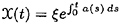
Problem 5.1 Before proceeding to the proof of the four assertions, let us observe that, in the case of the equation considered, every fundamental matrix is of type 1 1 and of the form
for every
, where
.
In view of Theorem 5.2.2, the null solution of the equation considered is stable if and only if there exists a fundamental matrix bounded on
, or equivalently every fundamental matrix is bounded on
. According to the remark from the beginning, this happens if and only if
| (*) | |
for every
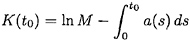
, t 0 ?t. If the mentioned inequality is satisfied, we have x(t) ?e K (0) for every
, and therefore x is bounded on
. Hence the null solution is stable. Conversely, if there exists M>0 such that x(t) ? M for every
, then from (*), one observes that the function
, which satisfies the inequality in question, can be taken
for every
.
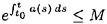
By virtue of Theorem 5.2.4, the null solution of the equation is uniformly stable if and only if there exists a fundamental matrix
(t) and there exists M>0 such that
for every
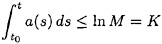
, t 0 ? t. According to the initial remark, the null solution is uniformly stable if and only if
for every
, t 0 ? t, or equivalently
for every
, t 0 ? t.
According to Theorem 5.2.2, the null solution is asymptotically stable...