Differential Equations: An Introduction to Basic Concepts, Results and Applications
Exercise 3.1
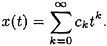
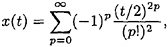
We look for the solution as a power series of the form
Imposing the condition that x satisfies the equation, we deduce
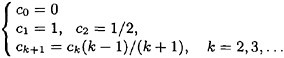
From the initial condition and identifying the coefficients, we get
from where it follows
the series being uniformly and absolutely convergent on [ ?1, 1].
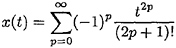
Proceeding as in the preceding exercise, we find
the series being absolutely convergent on
and uniformly convergent on every compact interval.
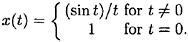
Similarly, we have
the series being absolutely convergent on
and uniformly convergent on every compact interval.
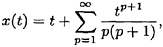
The solution of the equation is
for every
, i.e.
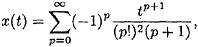
The solution of the equation is
for every
, i.e. x(t)=e t for every
.
The solution of the equation is
for every
, i.e.
for every
.
Problem 3.1 We look for x as
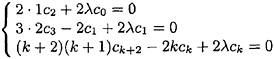
. Asking that x satisfy the equation, we obtain
. By identifying the coefficients, we get
for every
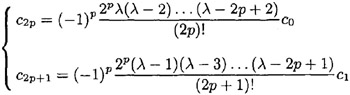
. From these equalities, we deduce
for every
. Taking successively ( c 0, c 1)=(1, 0) and ( c 0, c 1)=(0, 1), we get the solutions
and
both series being absolutely convergent on
, and uniformly convergent on every compact interval. Since the Wronskian of this system of solutions is nonzero at t=0, it follows that { x 1, x 2} is a fundamental system of solutions for the Hermite equation. If
, one can easily see that one of the two...