Differential Equations: An Introduction to Basic Concepts, Results and Applications
Chapter 2

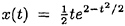
Exercise 2.1 (a) x(t)=t(2 ?t) ?1 for t ?[1, 2). (b) for t ?[2, + ?). (c) for . (d) for every t ?[0, 1). (e) x(t)= ? t ln t+2 t for t ?[1, + ?). (f) x(t)=(1 ?t 2)(2 t) ? 1 for t ?[1, + ?). (g) x(t)=t(ln t+1) ?1 for t ?[1, + ?). (h) for t ?[1, + ?). (i) x(t)= te t for t ?[1, + ?). (j) x(t)=( t 6+11)(6 t 2) ?1 for t ?[1, + ?). (k) x(t)=(e t ?e)t ? 1 for t ?[1, + ?). (l) x(t)=( t ln t ?1) ?1 for t ?[1, t*), where t* is the root of the transcendental equation t ln t ?1=0. (m) for t ?[1, e 4). (n) x(t)= t ?1 for t ?[1, + ?). (o) x(t)=(2 t ? t 2) ?1 for every t ?[1, 2). (p) x is implicitly defined by the equation x 3 ? x 2+ t 2=0 for t ?[1, + ?).

Problem 2.1 One may easily state that the function z

UNLIMITED FREE
ACCESS
TO THE WORLD'S BEST IDEAS

SUBMIT
Already a GlobalSpec user? Log in.

This is embarrasing...

An error occurred while processing the form. Please try again in a few minutes.

Customize Your GlobalSpec Experience

Category: Industrial Valves
Finish!
Privacy Policy

This is embarrasing...

An error occurred while processing the form. Please try again in a few minutes.