Elements Of Applied Probability For Engineering, Mathematics And Systems Science
5.3: Convergence to Steady-State

5.3 Convergence to Steady-State

The convergence of long run time averages to steady state investigated in the last section can be sharpened. For many chains, regardless of the initial distribution, the distribution after a very few transitions is approximately the stationary distribution!

Example 5.23: Bursty ATM traffic - (5.15) continued

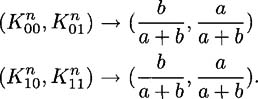
By the explicit calculation of K n we see that as n ? ?

In other words, it doesn't matter whether we started in 0 or 1, after some time we are in state 0 with approximate probability b/( a + b) and in state 1 with approximate probability a/( a + b). These are precisely the steady state probabilities of the ATM chain. We note, moreover, that it doesn't take long to enter the stationary regime since the term (1 ? a ? b) n converges to 0 exponentially fast.

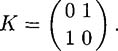
Things don't always work out so nicely even if a chain is irreducible. Consider a chain having kernel

Clearly, starting in state 0, after n steps we are in state 0 with probability 1 if n is even and 0 if n is odd. Similarly, starting in state 1, after n steps we are in state 1 with probability 1 if n is even and 0 if n is odd. It is clear K n 00 does not converge (but K 2 n 00 does) and this is a nuisance we will...

UNLIMITED FREE
ACCESS
TO THE WORLD'S BEST IDEAS

SUBMIT
Already a GlobalSpec user? Log in.

This is embarrasing...

An error occurred while processing the form. Please try again in a few minutes.

Customize Your GlobalSpec Experience

Category: Motor Starters and Contactors
Finish!
Privacy Policy

This is embarrasing...

An error occurred while processing the form. Please try again in a few minutes.