Elements Of Applied Probability For Engineering, Mathematics And Systems Science
Chapter 6: Renewal Theory

6.1 Introduction

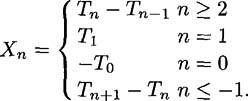
In this chapter, as in Chapter 4, we start with a simple point process { T n} ? n= ??; that is a strictly increasing sequence of random variables such that T 0 ? 0 < T 1. The interarrival or sojourn times relative to 0 are denoted:

As in Chapter 4 we assume that T n's cannot be measured more precisely than integer multiples of some time unit which might be nanoseconds. However, since every measurement in this chapter (except in Section 6.5) is in units we may as well just assume our measurements are integer valued and we suppress the notation. A value measured in units may be written with brackets when confusion is possible; hence [1] means one nanosecond unit. Functions and processes like f n[ x] and N[ t] below have square brackets to emphasize that they are defined only at nanosecond units and x and t are assumed to be measured in nanosecond units.

Definition 6.1

A simple point process, { T n}, is called a renewal process if the increments { T n ? T n ?1} ? n= ?? are independent, strictly positive, unit-valued random variables and T 0 = 0. The point process is called a delayed renewal process if T 0 ? 0. We denote the distribution of X n by F n having p.m.f. f n

UNLIMITED FREE
ACCESS
TO THE WORLD'S BEST IDEAS

SUBMIT
Already a GlobalSpec user? Log in.

This is embarrasing...

An error occurred while processing the form. Please try again in a few minutes.

Customize Your GlobalSpec Experience

Category: Oxidation Reduction Potential (ORP) Instruments
Finish!
Privacy Policy

This is embarrasing...

An error occurred while processing the form. Please try again in a few minutes.