Elements Of Applied Probability For Engineering, Mathematics And Systems Science

Consider a stationary Markov chain { X n; 0 ? n ? T} on a countable state space S having stationary probability measure ? and transition kernel K ij for i, j ? S. If we fix any time T, we may consider the time reversal of the original process, { X n* = X T ? n; 0 ? n ? T}, still defined on the same probability space. The evolution of this process is what we would get if we filmed the original chain from time 0 to T and then ran the film backward! Everyone knows this produces very strange results like the spilled glass of milk that reassembles itself from a million pieces and leaps up to a table top. In equilibrium however the time reversal is not so strange and is in fact just another Markov chain!
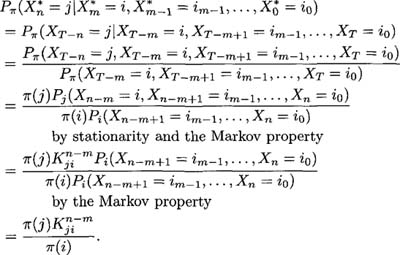
It is easy to establish the Markov property for the time reversed process and to identify the corresponding transition kernel. The Markov property holds since for 0 ? m < n ? T

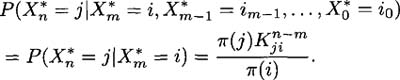
This means the conditional probability that the time reversed chain is in state j at time n, given the past at time m, depends only on the state at time m; i.e. on the fact that X m* = i. Hence,

This is precisely the Markov property and taking n = m