Elements Of Applied Probability For Engineering, Mathematics And Systems Science
5.11: Exercises

5.11 Exercises

Exercise 5.1

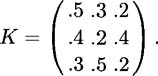
Consider a probability transition kernel K on three states: 0, 1, 2. Let the initial distribution be ? = (.2, .1, .7) and let the probability transition kernel K be

  1. Compute P( X 1 = 2 X 0 = 1).

  2. Compute P( X 21 = 2 X 20 = 1).

  3. Compute P( X 3 = 0, X 5 = 2, X 6 = 1 X 0 = 1).

  4. Compute EX 0.

  5. Compute E( X 0 X 0 = 1).

  6. Compute P( X 1 = 1).

  7. Compute EX 1.

  8. Compute E( X 1 X 0 = 1).

  9. Compute EX 1 2.

  10. Compute E( X 1 2 X 0 = 1).

  11. Compute Var( X 1 X 0 = 1).

  12. Compute P( X 0 = 1 X 1 = 2).

  13. Calculate the stationary probability measure associated with K.

  14. Calculate the mean number of transitions to return to 0.

Exercise 5.2

Consider the Markov chain X n in Exercise 5.1. Define Y n = ?{ X n ? {1,2}}, that is define Y n to be 1 if X n is either 1 or 2 and 0 if X n = 0. Is Y n a Markov chain?

Exercise 5.3

Consider a probability transition kernel K(

UNLIMITED FREE
ACCESS
TO THE WORLD'S BEST IDEAS

SUBMIT
Already a GlobalSpec user? Log in.

This is embarrasing...

An error occurred while processing the form. Please try again in a few minutes.

Customize Your GlobalSpec Experience

Category: Wireways
Finish!
Privacy Policy

This is embarrasing...

An error occurred while processing the form. Please try again in a few minutes.