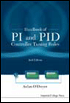
Handbook of PI and PID Controller Tuning Rules, 2nd Edition
Chapter 1: Introduction

1.1 Preliminary Remarks

The ability of proportional integral (PI) and proportional integral derivative (PID) controllers to compensate most practical industrial processes has led to their wide acceptance in industrial applications. Koivo and Tanttu (1991), for example, suggest that there are perhaps 5 10% of control loops that cannot be controlled by single input, single output (SISO) PI or PID controllers; in particular, these controllers perform well for processes with benign dynamics and modest performance requirements (Hwang, 1993; str m and H gglund, 1995). It has been stated that 98% of control loops in the pulp and paper industries are controlled by SISO PI controllers (Bialkowski, 1996) and that, in process control applications, more than 95% of the controllers are of PID type ( str m and H gglund, 1995). The PI or PID controller implementation has been recommended for the control of processes of low to medium order, with small time delays, when parameter setting must be done using tuning rules and when controller synthesis is performed either once or more often (Isermann, 1989).

However, despite decades of development work, surveys indicating the state of the art of control industrial practice report sobering results. For example, Ender (1993) states that, in his testing of thousands of control loops in hundreds of plants, it has been found that more than 30% of installed controllers are operating in manual mode and 65% of loops operating in automatic mode produce less variance in manual than in automatic (i.e. the automatic controllers are poorly tuned). The situation does not...

UNLIMITED FREE
ACCESS
TO THE WORLD'S BEST IDEAS

SUBMIT
Already a GlobalSpec user? Log in.

This is embarrasing...

An error occurred while processing the form. Please try again in a few minutes.

Customize Your GlobalSpec Experience

Category: Web Controllers
Finish!
Privacy Policy

This is embarrasing...

An error occurred while processing the form. Please try again in a few minutes.