High-Speed Optical Transceivers: Integrated Circuits Designs And Optical Devices Techniques

SHANTHI PAVAN [1]
Department of Electrical Engineering
Indian Institute of Technology Madras
Chennai 600 036, IndiaMAURICE TARSIA [2] , STEFFEN KUDSZUS, DAVID PRITZKAU
Bigbear Networks, 345 Potrero Avenue
Sunnyvale, CA 94085, USA
We present design considerations for high speed high swing differential modulator drivers in SiGe BiCMOS technology. Trade-offs between lumped and distributed designs, and linear and limiting amplifiers are examined. The design of a 6 V output modulator driver is discussed in detail. The driver features a unique bias generation and distribution circuit that enables low power-supply operation. Simulation results and measurements are given.
Keywords: modulator;driver;distributed;amplifier;limiting;bias;SiGe.
[1]shanthi@ee.iitm.ac.in
[2]tarsia@bigbearnetworks.com
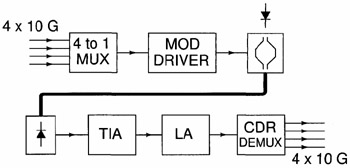
The seemingly insatiable demand for bandwidth has led to the deployment of optical networks operating at several tens of gigabits per second. Commercial time division multiplexed systems (TDM) running at 40 Gbps are now a reality.1 2 3 The block diagram of a typical OC-768 transceiver is shown in Figure 1. Four 10 Gbps datastreams are multiplexed together. This stream, with a data rate of 40 Gbps, is amplified and drives a Mach-Zehnder interferometric optical modulator. The optical modulator needs to be driven with a large differential waveform.
At the receiver, a photodiode is used to convert the optical signal into an electrical one. The photodiode current is amplified by a transimpedance amplifier (TIA) and further processed by a limiting amplifier, which converts the small signal TIA output to a large two-level signal. This in turn...