Introduction to Mathematics with Maple

The next few theorems are similar to theorems on limits of sequences or functions.
If f is integrable on [a, b] and c ?
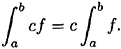
, then cf is integrable on [a, b] and
| (15.12) | |
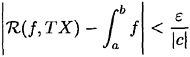
If c=0 the theorem is obvious. Let c ?0, ?>0. There exists a positive function ? such that
whenever TX ? ?. It follows that
If cf is integrable and c ?0 then f is also integrable and Equation (15.12) holds.
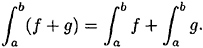
If f and g are integrable on [a, b] then so is f+g and
| (15.13) | |
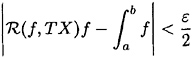
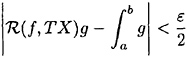
For every positive ? there exist positive functions ? 1 and ? 2 such that
| (15.14) | |
for TX ? ? 1, and
| (15.15) | |
for TX ? ? 2 . Define ?(x)=Min( ? 1 (x), ? 2 (x)). If TX ? ? then Inequalities (15.14) and (15.15) hold and since R(f+g, TX)=R(f, TX)+R(g, TX), we have
It is an easy exercise to extend Formula (15.13) to a sum of n functions.
If S is countable and f(x)=0 for x ? [a, b]\S then f is integrable and ![]()
The proof combines ideas from Examples 15.4 and 15.5.
Obviously we can assume that S is enumerable, (otherwise we enlarge it by joining it with an arbitrary enumerable part of [a, b]). Let n