Introduction to Mathematics with Maple

We encountered the Bolzano-Cauchy principle for limits of sequences and functions. For the integral it reads
A function f: [a, b]
is integrable if and only if for every positive ? there exists a gauge ? such that for any two tagged divisions TX ? ? and SY ? ?
The proof of the necessity of the condition is very similar to the proof of Theorem 10.16 and we therefore omit it.
Let ? n be the gauge associated with ?=1/ n by the condition of the theorem. We can assume that ? n ? ? n +1, otherwise we just replace ? n +1 (x) by Min( ? 1 (x), ? n (x)). For each n let us choose T n X n ? ? n . For n>N we have
| (15.20) | |
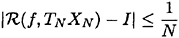
This implies that the sequence with terms equal to R(f, T n X n ) is Cauchy, so it has a limit, say I. Letting n ? ? gives
For a given positive ? let
and TX ? ? N . Then
With the Bolzano-Cauchy principle it is easy to prove integrability on subintervals.
If f is integrable on [a, b] and [ ?, ?] ?[a, b] then f is integrable on [ ?, ?].
We prove the theorem for a< ?=c