Introduction to Mathematics with Maple

Polynomial functions have always been important, if for nothing else than because, in the past, they were the only functions which could be readily evaluated. In this chapter we define polynomials as algebraic entities rather than functions, establish the long division algorithm in an abstract setting, we also look briefly at zeros of polynomials and prove the Taylor Theorem for polynomials in a generality which cannot be obtained by using methods of calculus.
If M is a ring and a 0, a 1, a 2, , a n ? M then a function of the form
| (6.1) | |
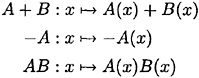
is called a polynomial, or sometimes more explicitly, a polynomial with coefficients in M. Obviously, one can add any number of zero coefficients, or rewrite Equation (6.1) in ascending order of powers of x without changing the polynomial. The domain of definition of the polynomial is naturally M, but the definition of A(x) makes sense for any x in a ring which contains M. This natural extension of the domain of definition is often understood without explicitly saying so. If A and B are two polynomials then the polynomials A+B, ?A and AB are defined in the obvious way as
The coefficients of A+B are obvious; they are the sums of the corresponding coefficients of A and B. The zero polynomial function is the zero function, that is