Introduction to Mathematics with Maple

15.8: Consequences of the Fundamental Theorem

15.8 Consequences of the Fundamental Theorem

The rule for differentiation of a product and the chain rule lead to theorems on integration by parts and substitution.

Theorem 15.16: (Integration by parts)

If F and G are continuous on [a, b], F'= f and G ?= g on [a, b] except on a finite set [9] then

(15.42)

Proof

We have ( FG)'= Fg+ Gf except on a finite set, the function FG is continuous on [a, b] and by the Fundamental Theorem, Equation (15.42) follows.

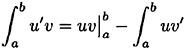
Provided that one of the integrals in Equation (15.43) below exists we obtain useful formula

(15.43)

The above formula is often rewritten in the easily remembered form

(15.44)

Example 15.21

The assumptions of the theorem alone do not guarantee the existence of either integral in Equation (15.43) as the following example shows. For F( x)= x 2 sin x ?4, G( x)= x 2 cos x ?4 for x ?0 and F(0)= G(0)=0 neither nor exists because then both would exist by Equation (15.43) and so would their difference. However F( x) g( x) ? G( x) f( x)=4 x ?1 is not integrable. For F and G chosen as above, Equation (15.42) holds but Formula (15.43) does not make sense. Moreover this example also shows that the product of an integrable function

UNLIMITED FREE
ACCESS
TO THE WORLD'S BEST IDEAS

SUBMIT
Already a GlobalSpec user? Log in.

This is embarrasing...

An error occurred while processing the form. Please try again in a few minutes.

Customize Your GlobalSpec Experience

Category: Industrial Valves
Finish!
Privacy Policy

This is embarrasing...

An error occurred while processing the form. Please try again in a few minutes.