Introduction to Mathematics with Maple

The Peano form of the remainder in the Taylor formula says that the remainder is smaller than the last term by an order of magnitude. Sometimes a more precise estimate is needed. It is provided by the next theorem.
If f, f', ,f ( n ) are continuous on an interval I with end-points a, b and f ( n +1) exists on I except possibly a finite subset of I, then the function t
f ( n +1)( t)( b ? t) n/ n! is integrable on I and
| (15.50) | |
where
| (15.51) | |
If one is prepared to use Exercise 15.7.6 then the exceptional set in the above theorem can be countable.
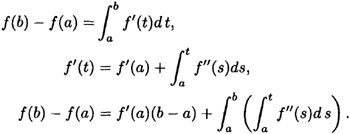
By induction. For n=0 the result is just the Fundamental Theorem. [12] For n=1 we have
Employing integration by parts (15.44) with u= t ? b and v'= f ? ? we have
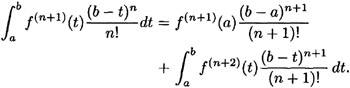
Turning to the induction hypothesis, by Equation (15.44) with u= f ( n +1) and v( t)=( b ? t) ( n +1)/( n+1)! we have (the existence of the first integral is guaranteed by the induction hypothesis)
This means
Equation (15.50) is often given a different form
These ways of writing the formula have the advantage that they do not suggest that h is positive or that x>