Partial Differential Equations: An Introduction with Mathematica and MAPLE, Second Edition
Chapter 3: One Dimensional Wave Equation

3.1 The Wave Equation on the Whole Line. D Alembert Formula

The simplest hyperbolic second-order equation is the wave equation

(3.1)

where x signifies the spatial variable or ( position , t the time variable, u = u ( x, t) the unknown function and c is a given positive constant. The wave equation describes vibrations of a string. Physically u ( x, t) represents the value of the normal displacement of a particle at position x and time t.

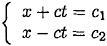
Using the theory of Section 2.2 the characteristic equation of (3.1) is


and


are two families of real characteristics. Introducing the new variables


and the function


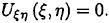
the equation (3.1) reduces to

(3.2)

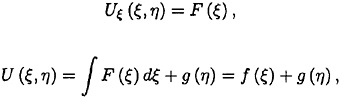
Therefore


and in the original variables u ( x, t) is of the form

(3.3)

known as the general solution of (3.1). It is the sum of the function g ( x ? ct) which presents a shape traveling without change to the right with speed c and the function f ( x + ct) - another shape, traveling to the left with speed c.

Consider the Cauchy (initial value) problem for (3.1)


where ? and ? are arbitrary functions of x. Further we denote R + = { t : t ? 0}.

Theorem 3.3

( D Alembert [1] formula). If ? ? C 2 (R) and ? ? C 1 (

UNLIMITED FREE
ACCESS
TO THE WORLD'S BEST IDEAS

SUBMIT
Already a GlobalSpec user? Log in.

This is embarrasing...

An error occurred while processing the form. Please try again in a few minutes.

Customize Your GlobalSpec Experience

Category: Wave Washers
Finish!
Privacy Policy

This is embarrasing...

An error occurred while processing the form. Please try again in a few minutes.