Partial Differential Equations: An Introduction with Mathematica and MAPLE, Second Edition
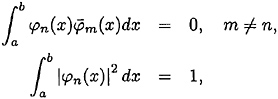
The system of complex-valued functions { ? n( x)} defined on the interval I = [ a, b] is said to be orthonormal iff
for every m, n ? N.
For example, the system
is orthonormal on [ ? ?, ?].
Let { ? n( x)} be an orthonormal system and f( x) be an absolutely integrable function on [ a, b]. Then the numbers
are well-defined and are called the Fourier coeficients of f with respect to { ? n}. We write as before
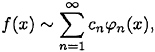
where the series is called the Fourier series of f with respect to { ? n}.
The partial sums of the Fourier series have a minimal property in L 2-sense.
Let f ? L 2[ a,b] and { ? n} be an orthonormal system in L 2[ a, b] . Then the function
attains its minimum at the point ( c 1 , , c n) , where c k is the k-th Fourier coefficient of f.
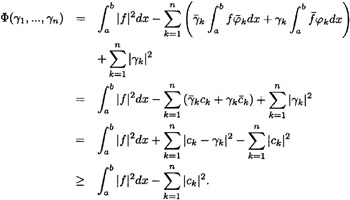
By the orthonormality of the system { ? n} we have
| (7.34) | |
By (7.34) it follows that ?( ? 1 , , ? n) is minimal at ( c 1 , , c n) and
| (7.35) | |
Let f ? L 2[ a, b