Partial Differential Equations: An Introduction with Mathematica and MAPLE, Second Edition
Consider the Cauchy problem ( CW). It was noted in Section 3.1 that to have a solution u ? C 2 (R R +) of ( CW) we require ? ? C 2 (R) and ? ? C 1 (R). If the last assumptions are not satisfied then the solution given by D Alembert formula is not a classical solution. How to justify the meaning of a solution in this case? There exist two main approaches. One is to introduce the so called weak derivatives so that the wave equation is satisfied in a form of integral identity. The other is the sequential approach. Consider approximating problems with smooth data ( ? k, ? k) ? C 2 ( R) C 1 (R). It is possible to define a weak ( generalized) solution of the problem by passing to the limit in L 2 spaces of corresponding solutions u k. We prove that in some sense these two approaches are equivalent.
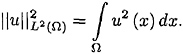
Let L 2 ( ?) be the usual Lebesgue space of square integrable functions u : ? ? R, where ? is a measurable domain in R n. L 2 ( ?) is a Banach space with a norm
Denote by
( ?) the space of test functions, i.e. all functions ? ( x)