Partial Differential Equations: An Introduction with Mathematica and MAPLE, Second Edition
We consider now the Laplace equation
| (7.71) | |
where D = {( x, y) : 0 < x < a, 0 < y < b} is a rectangle in a plane. On each side of D we assume that either Dirichlet or Neumann boundary conditions are prescribed. These problems can be solved by the method of separation of variables.
Solve (7.71) with the boundary conditions
Solution. The solution of the problem has a form u = u 1 + u 2, where u 1 and u 2 satisfy (7.71) respectively with the boundary conditions
and
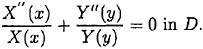
We find each one of u 1 and u 2 by the Fourier method. Separating variables for u 1 ( x, y) = X ( x) Y ( y) we have
This implies that
| (7.72) | |
| (7.73) | |
for a constant ?. Since the function u 1 satisfies ( BC 1) we should have
| (7.74) | |
| (7.75) | |
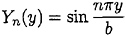
Nontrivial solutions of (7.73), (7.74) are
corresponding to
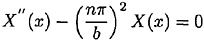
The differential equation for X( x)
implies that
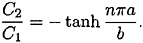
The condition (7.75) is satisfied if
Then X( x) has the form
We are looking for a solution u 1 of the form
| (7.76) | |
It satisfies the boundary condition
when
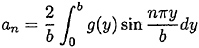
which implies that
| (7.77) | |
Suppose now u 2