6.1 Harmonic Functions. Maximum-minimum Principle
The Laplace [1] equation or potential equation is
| (6.1) | 
|
where ? u is the Laplacian of the function u
A function u ? C 2 ( ?) which satisfies the Laplace equation is called a harmonic function. The inhomogeneous Laplace equation
where f is a given function is known as the Poisson equation.
The Laplace equation is very important in applications. It appears in physical phenomena such as
-
Steady-state heat conduction in a homogeneous body with constant heat capacity and constant conductivity.
-
Steady-state incompressible fluid flow.
-
Electrical potential of a stationary electrical field in a region without charge.
The basic mathematical problem is to solve the Laplace or Poisson equation in a given domain possibly with a condition on its boundary ? ? = ?\ ?.
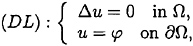
Let ? and ? be continuous functions on ? ?. The problem of finding a function u ? C 2( ?) ? C( ?) such that
is called the Dirichlet or first boundary value problem (BVP) for the Laplace equation. Historically, the name boundary value problem was attributed to only problems for which the PDE was of the elliptic type. Today we use this term in a much wider sense.
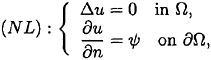
The Neumann or second BVP is
where  denotes the outward unit normal to ? ? and
  derivative.
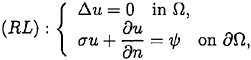
The Robin or third BVP is
where ? is a continuous function...

 TABLE OF CONTENTS