Practical Guide to Blow Moulding

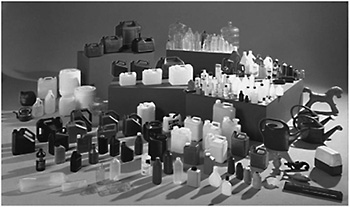
Blow moulding is a process of producing hollow or double wall objects from thermoplastic materials [1] (See Figure 1.1).
The basic process is common to all variations of the blow moulding method, which consists of three stages [2]:
Melting and Plasticising This is accomplished with either extrusion and/or injection moulding machine to produce the melt.
Plastic Formation Through head and die or in an injection mould.
Blowing and Moulding An auxiliary compressor provides air pressure and a clamp unit, which closes over a split mould that is operated with an hydraulic system.
The first step involves the production of a hot tube, known as a parison, a term derived from the glass industry. This may be produced, as indicated, by one of two methods, extrusion or injection. In the injection case it is referred to as preform.
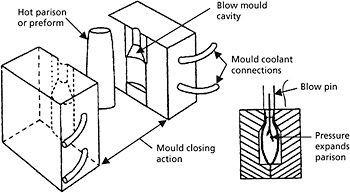
The heated parison or preform is placed between two halves of the blowing mould, which closes and clamps around it. The heated tube is blown against the cavity wall and the molten plastic or resin takes the shape of the mould while being cooled. This is illustrated in Figure 1.2. After the cooling stage the part is ejected from the mould. In the case of an extruded part it is necessary to remove the flash (excess plastic around the part) for further finishing.
Drilling, labelling or printing may...