Practical Guide to Blow Moulding

The finishing of a blow moulded part should be considered in the product design, mould engineering, and process planning phases.
A good way to do this when in the initial stages of part design is to imagine that the mould has opened but the part is still hanging in the mould, and the flash is still attached. Depending on the part and process, the following secondary operations may need to be considered:
Removing a dome or other sections from the part body.
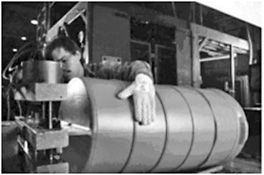
Removing the flash and performing drilling operations (see Figure 10.1).
Figure 10.1: Finishing an extrusion blow moulded traffic safety barrel
Reproduced with permission from Crocker Limited, Three Rivers, MI, USA.
Decorations: hot stamping, heat transfer and serial numbering by the hot stamp method.
Automatic weighing and recording equipment.
Safety: ergonomics and noise control.
The following considerations should be made in the planning for the finishing of blow moulded parts:
Radii, no square corners in either inside or outside.
Wherever possible, include orientation and register features, for positioning and holding in downstream tasks.
Lay out flash pockets in the product drawing.
Wide enough to accept normal flash variations
Circumferential flash is to be avoided, if at all possible.
When circumferential flash is unavoidable, compensate for it in the mould design.