Practical Guide to Blow Moulding

Co-extrusion refers to the technology used to make products that contain multiple layers in their wall structures. Such products are said to be co-extruded. The layers may be made of the same or different materials, coloured or uncoloured material, or recycled and virgin materials. Packaging of various types is the primary application of co-extruded products, as better barrier properties are the main reason for the multilayer structure.
The multi-layered structure of co-extruded products is created by combining two or more melt layers in the die head before their extrusion as a parison. The main difference between multiple layer and single material extrusion blow moulding is in the extrusion system. In co-extrusion, each material is extruded from its own extruder. Examples of products made from this process are ketchup bottles and automotive gas tanks.
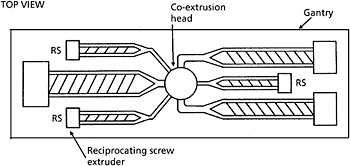
An arrangement of extruders to produce co-extruded, multi-layer structures is illustrated in Figure 5.1.
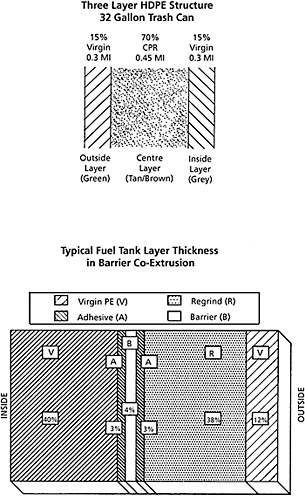
A coextruded, multi-layered structure (Figure 5.2) may be created to provide one or more characteristics that cannot be provided by a single-layer product. These may be based on a physical requirement, for example, a better heat barrier or increased resistance to permeation. Also, cost considerations may require that a virgin wall material be replaced by reclaimed material, or that a costly colour be used in only one layer of the structure instead of throughout the entire wall thickness.