Practical Guide to Blow Moulding

The mould determines the shape of the end product with all its details. It helps provide an end product with the essential physical properties and the desired appearance. Usually, the mould maker builds the blowing mould according to the holder s or his customer s specifications. But frequently, minor adjustments or improvements, which would not justify its being returned to the mould maker, can be made with equipment and knowledge available in the blow moulding shop.
The blowing mould may have a number of parts, counting its various inserts, but it usually consists of two halves. When closed, these halves will form one or more cavities which will enclose one or more parisons for blowing. The two mould halves are usually alike. There are usually no male and female sections.
Pinch-off edges are generally provided at both ends of the mould halves. A blowing pin may have the additional function of shaping and finishing the neck inside.
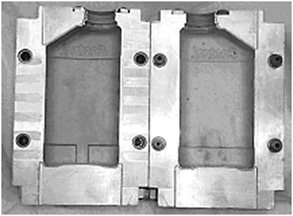
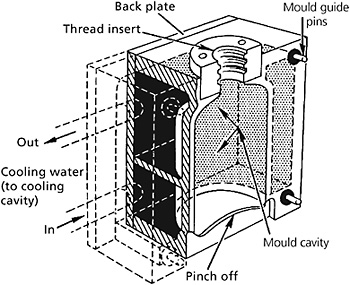
Both mould halves must have built-in channels for the cooling water. Sets of guide pins and bushings or side plates in both mould halves ensure perfect cavity alignment and mould closing. Accurate guiding devices in both mould halves reduce setup time. Figure 3.1 shows the two halves of a blowing mould for small bottles. Figure 3.2 shows basic features and the location of the cooling-water channels.
On some blowing presses, mould closing is carried...