40 Principles Extended Edition: TRIZ Keys to Technical Innovation, Volume 1

By Genrich Altshuller

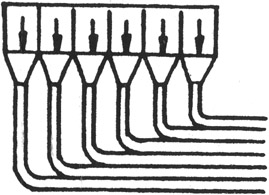
Divide an object into independent parts.
| A 90-degree elbow in a large air duct is segmented for better air flow and turbulence reduction. |
|
![]() |
Make an object sectional (for easy assembly and disassembly).
| The pole of a temporary street light is made of elements connected with flexible joints for easy transportation and installation. |
|
![]() |
Increase the degree of an object's segmentation.
| Development of a Roller Conveyor. |
|
![]() |
Principle Number: 1
Principle Name: Segmentation
Principle Description:
Segmentation is a process of artificially or actually dividing a system into parts in order to isolate or integrate a beneficial or harmful system property. In most cases, segments are reassembled (integrated) to perform some new functionality and/or eliminate a problem.
Hints on Usage:
Assess the system to be segmented in order to change the part of the system that contains a challenge. For example, if the system contains an excess weight challenge then assess ways to segment the system in order to provide several sufficiently lightweight subsystems; if the system is too big for physical handling then look for ways to segment the system so each piece is easy to handle.
Keep in mind that segmentation is applicable beyond geometric uses. It can be used in such non-physical areas as psychological segmentation and the integration of ideas.
The segmentation principle may be used to create new or useful system properties. It can also be applied across scales: from nano-scale to the scale of galaxies.
Comment:
Notice in the examples below that...