40 Principles Extended Edition: TRIZ Keys to Technical Innovation, Volume 1


Replace symmetrical form(s) with asymmetrical form(s).
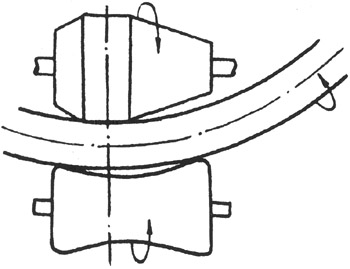
| A device to straighten a wire consists of two rollers, convex and concave, made asymmetrical around the y-axis to speed production and increase quality. |
|
![]() |
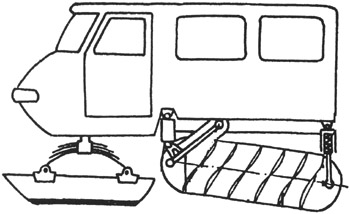
| The driving drum of a snowmobile is positioned under the vehicle at an angle to better grip the snow. |
|
![]() |
If an object is already asymmetrical, increase its degree of asymmetry.
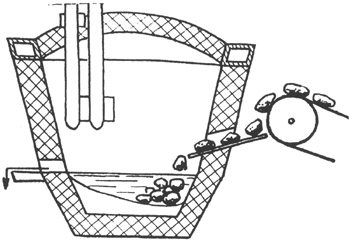
| An electrical furnace has electrodes asymetrically placed permitting the continuous loading of ore and the discharge of molten metal. |
|
![]() |
Principle Number: 4
Principle Name: Asymmetry
Principle Description:
Asymmetry involves transitioning from isotropic to anisotropic, or vice versa. Isotropic means symmetrical regardless of measurement direction or object orientation. Anisotropic means asymmetrical, or different depending on the object's orientation and/or the direction in which it is measured.
Hints on Usage:
Obviously, asymmetry may be applied to a physical geometry. Less obviously, asymmetry can be applied to any interaction.
Start by assessing the reason why symmetry is part of the current system design. Many times it is symmetrical because "it has always been done that way" whether it is most efficient or not. For example, a compass is a handy, common tool historically used for drawing circles. So handy is the compass that many parts are drawn round just because it is easier than drawing it any other way. If a part is too heavy, however, its shape can be changed to eliminate excess weight by shaving off parts that do not add value.
The Principle of Asymmetry may...