Advanced Dynamics
Emphasizing learning through problem solving, this text analyzes in detail the strengths and weaknesses of various approaches to dynamics, and describes techniques that will improve computational efficiency considerably.
 TABLE OF CONTENTS
 In our study of the dynamics of a system of particles, we have been concerned primarily with the Newtonian approach which is vectorial in nature. In general, we need to know the magnitudes and directions of the forces acting on the system, including the forces of constraint. Frequently the constraint forces are not known directly and must be included as additional unknown variables in the equations of motion. Furthermore, the calculation of particle accelerations can present kinematical difficulties.
An alternate approach is that of analytical dynamics, as represented by Lagrange's equations and Hamilton's equations. These methods enable one to obtain a complete set of equations of motion by differentiations of a single scalar function, namely the Lagrangian function or the Hamiltonian function. These functions include kinetic and potential energies, but ideal constraint forces are not involved. Thus, orderly procedures for obtaining the equations of motion are available and are applicable to a wide range of problems.
Let us begin with Newton's law of motion applied to a system of N particles. For the ith particle of mass m i and inertial position r i, we have
| (2.1) |  |
where F i is the applied force and R i is the constraint force. Now take the scalar product with a virtual displacement ? r i and sum over i. We obtain
| (2.2) | 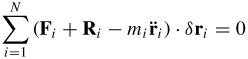 |
This result is valid for arbitrary ? rs; but now assume...