Advanced Dynamics

Emphasizing learning through problem solving, this text analyzes in detail the strengths and weaknesses of various approaches to dynamics, and describes techniques that will improve computational efficiency considerably.
 TABLE OF CONTENTS
 An important consideration in the numerical analysis of dynamical systems lies in the proper representation of kinematical constraints. Even if the physical system is stable, there may be numerical instabilities resulting from the method of applying constraints. In this section, we shall present methods of representing constraints and will analyze their stability.
Let us consider first a dynamical system which is subject to m holonomic constraints of the form
| (6.284) |  |
Suppose there are n second-order dynamical equations written in the fundamental La-grangian form
| (6.285) |  |
where the ?s are Lagrange multipliers, the Qs are generalized applied forces, and where
| (6.286) | 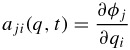 |
At this point there are n dynamical equations which are linear in the n  s and the m ?s. We need m additional equations to solve for the variables. These additional equations can be obtained by differentiating the constraint equations twice with respect to time. First,
| (6.287) | 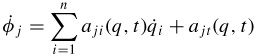 |
where
| (6.288) | 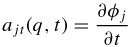 |
Then  has the form
| (6.289) |  |
If these expressions for  are set equal to zero then, with the aid of (6.285), one can solve for the
  ( q,
( q,  , t) and ? j( q,
  , t). The n
  expressions can be integrated numerically for given initial conditions, thereby obtaining
  and q i as functions of time.
The problem with this approach is that the resulting numerical solutions will be unstable even though the physical system may actually...