Advanced Dynamics

Emphasizing learning through problem solving, this text analyzes in detail the strengths and weaknesses of various approaches to dynamics, and describes techniques that will improve computational efficiency considerably.
 TABLE OF CONTENTS
 In assessing the accuracy of numerically computed solutions of the equations of motion of a dynamical system, it is helpful to have relatively simple check solutions available. A common approach is to use integrals of the motion, that is, functions whose values remain constant during the course of the solution, as checks on accuracy. For example, the energy integral E = T 2 - T 0 + V may be used for conservative systems. Other systems may have one or more components of momentum or angular momentum conserved. Integrals of the motion are particularly effective in detecting programming errors. Of course, these methods are ineffective against errors in the values of the physical parameters.
Let us consider a conservative system whose energy integral has the form
| (6.438) |  |
At each time step in the numerical solution, we wish to correct for an energy error ?E given by
| (6.439) |  |
where E 0 is evaluated from the initial conditions.
First let us note that, for a given configuration and energy constant E 0, the equation
| (6.440) |  |
represents a surface in n-dimensional velocity space (Fig. 6.9). Since the kinetic energy function T( q,  ) is positive definite and quadratic in the
  s, the form of the energy surface is ellipsoidal for the particular case of 3-space.
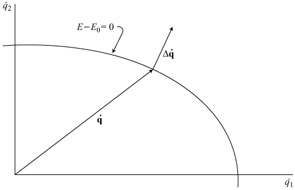
The velocity correction ?  will be taken in the direction normal to the energy surface, that is, in...