Advanced Dynamics

Emphasizing learning through problem solving, this text analyzes in detail the strengths and weaknesses of various approaches to dynamics, and describes techniques that will improve computational efficiency considerably.
 TABLE OF CONTENTS
 Consider a linear time-invariant system which has a sinusoidal input. The steady-state output will be sinusoidal with the same frequency as the input but, in general, with a different amplitude and phase. If one uses complex notation, the amplitude and phase of the output relative to the input are expressed by the transfer function
| (6.217) | 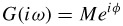 |
where M( ?) is the relative amplitude and ?( ?) is the relative phase.
The system under consideration may be originally linear or may be a linearized system which is represented by a set of perturbation equations. The data resulting from a numerical integration of the linear equations can be considered to be samples taken from a continuous output, albeit an output slightly in error compared to the true output. The transfer function relating this computed output to the same sinusoidal input is of the form
| (6.218) |  |
where M* and ?* are functions of ?. Our problem is to find the relationship of G* ( i ?) to G( i ?) for some combination of linear equations and integration algorithm.
As a simple example, consider a pure integrator with a unit sinusoidal input. Its differential equation can be written in the complex form
| (6.219) |  |
Let us use the Euler integration algorithm and the discrete time
| (6.220) |  |
We obtain the difference equation
| (6.221) |  |
The steady-state solution of this equation has the form
| (6.222) |  |
where G*( i