Advanced Dynamics

Emphasizing learning through problem solving, this text analyzes in detail the strengths and weaknesses of various approaches to dynamics, and describes techniques that will improve computational efficiency considerably.
 TABLE OF CONTENTS
 In the study of dynamical systems we consider, in general, ordinary differential equations with time as the independent variable. If one uses Lagrangian methods, the resulting second-order equations of motion are nonlinear, in general, but are always linear in the  Usually each second-order differential equation is converted to two first-order equations before numerical integration takes place, resulting in the solution for the dependent variables as functions of time. Numerical integration is accomplished by first converting the differential equations to difference equations. These equations are then solved at discrete instants of time. The solutions of the difference equations ideally should be the same as the solutions of the differential equations evaluated at the discrete times. Now let us consider some of the numerical procedures or algorithms used in the integration of ordinary differential equations. The errors associated with these methods will be evaluated.
Let us begin with a single first-order differential equation
| (6.51) |  |
Choose a step size ? t = h and assume that the initial condition y( t 0) = y 0 is given. The numerical solution for y( t) at t = t 1, t 2, t 3, ... is obtained by repeating the following sequence of calculations:
| (6.52) | 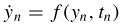 |
| (6.53) |  |
for n = 0, 1, 2, .... Note that the result of the first calculation is used in the second, and the result of the second calculation is used...