Advanced Dynamics

Emphasizing learning through problem solving, this text analyzes in detail the strengths and weaknesses of various approaches to dynamics, and describes techniques that will improve computational efficiency considerably.
 TABLE OF CONTENTS
 One of the recurring problems in the numerical analysis of physical systems is that the numerical results may show an instability which is not present in the physical system. The stability of a numerical method depends on the step size h and on the stability characteristics of the physical system. Other factors may influence the stability, including the numerical methods used in representing constraints. In this section, we will consider the numerical stability characteristics of various integration algorithms.
Consider first the relatively simple case of a single first-order differential equation
| (6.159) |  |
The Euler algorithm is
| (6.160) |  |
The numerical stability is analyzed by the perturbation equation
| (6.161) |  |
where we use the notation
| (6.162) | 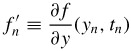 |
We consider (6.161) as a difference equation in ?y and assume that  varies slowly enough that it can be assumed to be constant. Let
| (6.163) |  |
where ? is a real constant. Then (6.161) becomes
| (6.164) |  |
Now assume a solution of the form
| (6.165) |  |
where A is a constant and ? is the ratio ?y n +1 / ?y n. From (6.164) and (6.165) we obtain
| (6.166) |  |
We seek nonzero values of ? in order to avoid trivial zero solutions for ?y. Thus, we obtain
| (6.167) |  |
The necessary condition for numerical stability is that ? ? 1. The step size h is assumed to be positive, and we see that -2 ? ? h ?