Advanced Engineering Chemistry, Second Edition
John Dalton's concept of indivisibility of the atom is discarded by the discovery of various fundamental particles.
An atom consists of three fundamental particles:
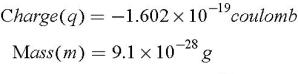
Electron: A negatively charged particle with almost negligible mass, which was discovered by J. J. Thomson from the studies carried out on cathode rays in the discharge tube. The name electron was proposed by Stoney.
![]()
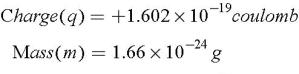
Proton: A positively charged particle with mass nearly 1840 times heavier than the mass of an electron. The proton was discovered in the anode ray experiment. The magnitude of charge is the same as that of an electron.
![]()
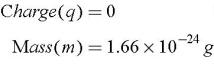
Neutron: A neutral particle with no charge, which was discovered by James Chadwick (1932). Its mass is nearly the same as that of a proton.
![]()
The atom is the smallest unit of an element that retains the characteristic properties of the element.
After the discovery of protons and electrons, Thomson suggested his model of the atom. According to Thomson, an atom consists of a sphere of positive electricity in which electrons are embedded like the plums in a pudding. This model could not explain the experimental facts and was discarded.
Rutherford (1911) bombarded a thin sheet of gold (10 ?4 mm) with high-speed ?-particles. ?-particles (He 2+) are obtained from a radioactive substance. A thin lead plate with a hole serves to form a beam of ?-particles.