Advanced Engineering Chemistry, Second Edition

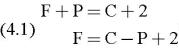
The phase rule put forward by Williard Gibbs (1876) is the most useful generalization concerning the equilibria in heterogeneous systems. The phase rule is a relation between the number of components (C), the number of phases (P), and the variable parameters (F) of a heterogeneous system in equilibrium. It is expressed as
The phase rule may be defined as, "in a heterogeneous system in equilibrium the number of degrees of freedom plus the number of phases equal the number of components plus 2."
A phase is that part of a system that is chemically and physically uniform throughout. A phase is defined as any homogeneous and physically distinct part of a system that is separated from other parts of a system by definite boundary surfaces. For example:
One liquid layer constitutes one phase, whether it is pure or a mixture.
Two liquid layers in contact represent two phases because there is a definite surface of separation between them ( i.e., benzene and water).
A gas or a mixture of gases constitutes one phase, because the system is homogeneous ( i.e., N 2 and H 2).
Every solid constitutes a separate phase except in case of a solid solution ( i.e., sulphur).
All homogeneous solutions are one-phase systems.
A heterogeneous system is composed of two or more phases.
The number of components is defined as the least number of independent chemical constituents necessary to express...