Advanced Engineering Chemistry, Second Edition
Electrochemistry is a science that deals with the transformation of chemical energy into electrical energy, and vice versa. The process of transforming electrical energy into chemical energy is called electrolysis. The apparatus used for electrolysis is called an electrolytic cell in which electrical energy is used to cause a chemical reaction to take place. Faraday found out that there were quantitative relations between the amount of electricity flowing through the electrolyte and the amount of chemical change occurring at the electrodes. These relations came to be known as Faraday's law.
The two laws discovered by Faraday are stated as follows:
First law of electrolysis: The law states that the amount of substance deposited or evolved at any electrode is proportional to the quantity of electricity passed through the electrolyte.
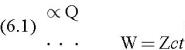
Suppose Wg of the substance is deposited at an electrode when Q coulombs of electricity are passed.
Then
![]()
When Z is a constant called the electrochemical equivalent, it is the quantity of substance produced when 1 coulomb of electricity is passed that is, a unit current (1 amp) is passed for 1 second. c is the current in amperes, and t is the time in seconds. Every substance possesses a definite electrochemical equivalent (Z). An electrochemical equivalent may be defined as the amount of substance deposited by 1 ampere of current passing for 1 second ( i.e., 1 coulomb).
Second law of electrolysis: According to this law, if...