Advanced Engineering Chemistry, Second Edition
Part 3 :

CHAPTER LIST

Experiments: Experiments

EXPERIMENT 1

Aim of the experiment:

Determination of sodium hydroxide and sodium carbonate in a mixture.

Apparatus required

Burette

Pipette

Conical flask

Glazed tile

Chemicals required:

Given alkali mixture solution

HCl solution

Phenolphthalein indicator

Methyl orange indicator

Theory:

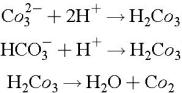
To determine NaOH and Na 2CO 3 when present together, the double indicator method is generally employed. The principle involved in this method is that when a sodium carbonate solution is titrated with hydrochloric acid, the neutralization occurs in two stages. The first one correspond to the hydrogen carbonate (HCO 3 ?) stage, when the net reaction is


The equivalence point for the primary stage of ionization of carbonic acid is at pH 8.3, which may be detected by employing a phenolphthalein indicator. The second stage of the titration corresponds to the displacement of all the carbonic acid, when the net reaction is


The equivalence point for the secondary stage of ionization is at pH range 3.1 to 4.4, which may be detected by employing the methyl orange indicator. Thus, when a mixture of Na 2CO 3 and NaOH is titrated with standard HCl, the phenolphthalein end point corresponds to the neutralization of all the NaOH and the partial neutralization of all the Na 2CO 3 to the bicarbonate stage.


Now if the titration is continued using methyl orange as the indicator, the neutralization of the bicarbonate to the carbonic acid occurs.


So, the methyl orange end point means the

UNLIMITED FREE
ACCESS
TO THE WORLD'S BEST IDEAS

SUBMIT
Already a GlobalSpec user? Log in.

This is embarrasing...

An error occurred while processing the form. Please try again in a few minutes.

Customize Your GlobalSpec Experience

Category: Neutralization Equipment
Finish!
Privacy Policy

This is embarrasing...

An error occurred while processing the form. Please try again in a few minutes.