Advanced Engineering Chemistry, Second Edition
Chapter 5: Chemical Kinetics and Catalysis

5.1 INTRODUCTION

Chemical kinetics is the branch of physical chemistry that deals with a study of the speed of chemical reactions. Such studies also enable us to understand the mechanism by which the reactions occur. This reveals not only the influence of different factors on the progress of the reaction, but it also throws light on the mechanism through which reactant molecules are transformed into products. The knowledge of the rate of reactions is very valuable for the success of an industrial process to give maximum yield.

5.2 RATE OF REACTION

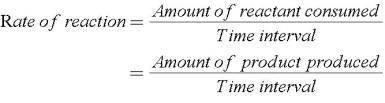
The rate of reaction, that is the velocity of a reaction, is the amount of chemical change occurring per unit time. The rate is generally defined as the decrease in the concentration of the reactant or an increase in the concentration of the products per unit time. Mathematically, the rate of reaction can be expressed as


Consider a simple hypothetical reaction of the type


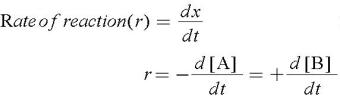
The rate of the reaction at any given time will be given by


where [A] and [B] indicate the concentration of A and B, respectively.

The rate of reaction is invariably a positive quantity. The negative sign merely indicates that the concentration of the reactant is falling with the increase in time, whereas the positive sign indicates the increase in concentration of the product with the increase in time.

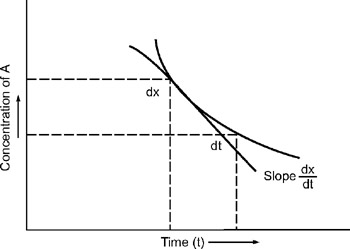
The numerical value of can be obtained from a plot of the concentration of a reactant (or product) versus time (Fig. 5.1).


Figure...

UNLIMITED FREE
ACCESS
TO THE WORLD'S BEST IDEAS

SUBMIT
Already a GlobalSpec user? Log in.

This is embarrasing...

An error occurred while processing the form. Please try again in a few minutes.

Customize Your GlobalSpec Experience

Category: Catalysts and Initiators
Finish!
Privacy Policy

This is embarrasing...

An error occurred while processing the form. Please try again in a few minutes.